Top 10 Football Games of All Time: A Gamer's Guide
What Makes a Football Game "All-Time Great"?
A football game earns "all-time great" status when it does more than simulate the sport — it captures the feeling of playing it. Sales numbers matter far less than whether a game makes you lean forward in your seat when you're one-nil down in the 89th minute.
Four criteria separate the legends from the also-rans:
- Gameplay depth — Does the control scheme reward skill, or does button-mashing win every game?
- Innovation — Did the game introduce mechanics the whole genre later borrowed?
- Legacy — Are people still talking about it, emulating it, or streaming it years later?
- Fun factor — This one's non-negotiable. A game can be technically impressive and still be a chore to play.
The balance between realism and arcade-style gameplay is where most debates happen. Simulation fans want authentic physics and tactical depth. Casual players want to pick up a controller and score a bicycle kick in thirty seconds. The best football games find a way to satisfy both crowds — or at least commit fully to one direction without apology.
The Golden Age — Classic Titles That Defined the Genre
The foundations of football gaming were laid on hardware that could barely render eleven players on screen simultaneously — and somehow, those games were brilliant.
Tecmo Super Bowl (1991, SNES/NES) is technically an American football title, but its influence on sports game design — real player names, season modes, AI behavior — rippled directly into association football games throughout the decade. It proved that licensed, stat-driven sports games had a massive audience.
Sensible Soccer, released in 1992, took a completely different path. Developed by Sensible Software, it used a top-down perspective and fast, fluid movement that felt nothing like real football and everything like the best version of it. The aftertouch mechanic — curling shots by nudging the joystick after striking the ball — was genuinely revolutionary. Decades later, players still argue it had the most satisfying shooting system ever built.
Then came International Superstar Soccer (ISS) on the SNES, Konami's first serious attempt at the genre. It introduced momentum-based dribbling and goalkeeping animations that looked almost cinematic by 1994 standards. ISS planted the seed that would eventually grow into Pro Evolution Soccer — and later reshape the entire market.
These early titles share something modern games rarely achieve: simplicity that hides surprising depth. You could learn the controls in five minutes and spend five hundred hours mastering them.
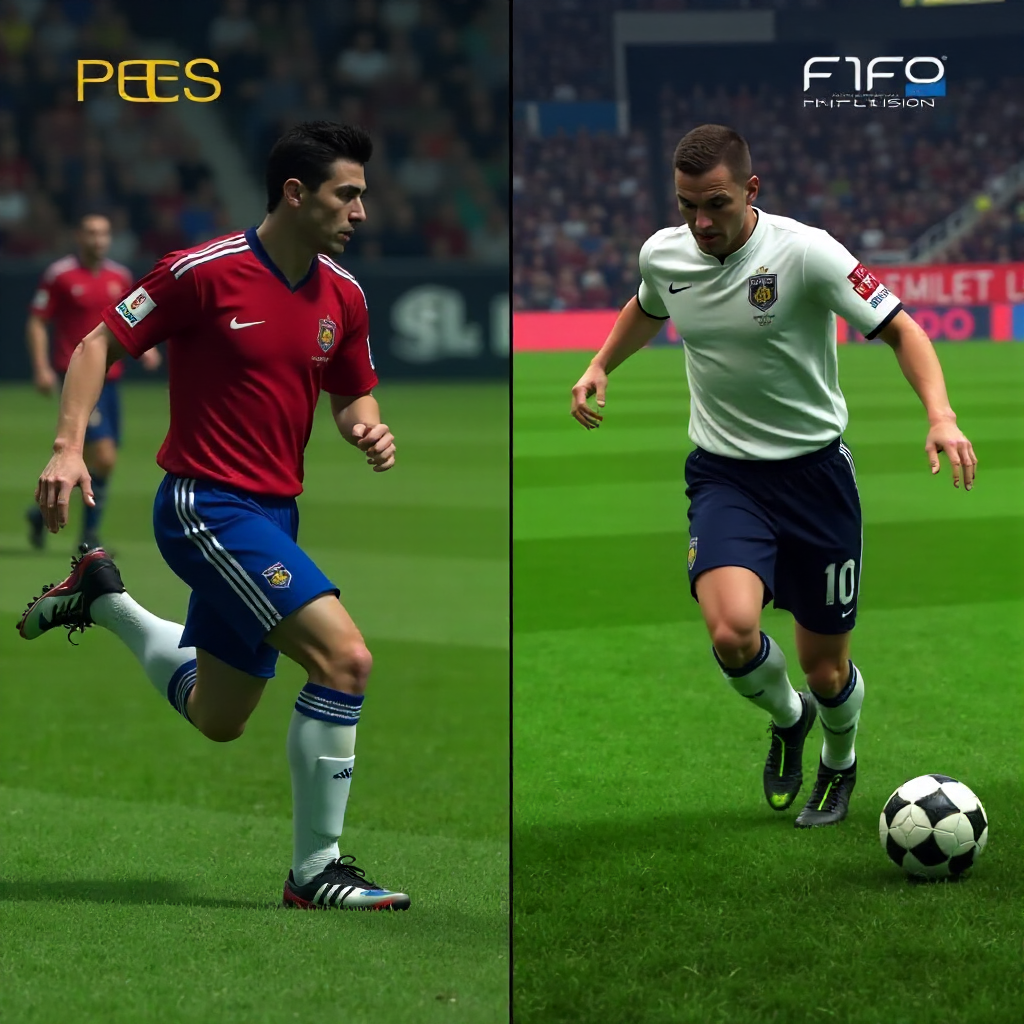
The FIFA vs. PES Rivalry — Two Franchises That Shaped Modern Football Gaming
The FIFA vs. PES debate dominated football gaming for roughly fifteen years, and it produced some of the greatest individual entries the genre has ever seen.
EA Sports launched FIFA in 1993 with a landmark feature: official licensing. Real teams, real kits, real stadiums. It wasn't the most sophisticated game mechanically, but walking out at Wembley as England felt different from playing as "Manchester Blue." That authenticity gap gave FIFA a commercial edge it never fully surrendered.
Pro Evolution Soccer fought back with gameplay. PES 3, PES 4, and PES 5 (released between 2003 and 2005 on PS2) are still cited by simulation fans as the high-water mark of football game mechanics. The weight of the ball, the individuality of player movement, the tactical flexibility — nothing else came close. PES 5 in particular had a passing system so nuanced that online communities developed entire coaching guides around it.
FIFA's peak arguably came between FIFA 12 and FIFA 17, when the introduction of the Impact Engine, improved career mode depth, and the explosion of Ultimate Team created an ecosystem that was genuinely hard to walk away from. Ultimate Team's card-collecting structure was controversial — and remains so — but it transformed football gaming into a year-round engagement rather than a seasonal purchase.
The rivalry cooled when Konami rebranded PES as eFootball in 2021 and shifted to a free-to-play model. The launch was rough. EA, meanwhile, lost the FIFA license in 2023 and rebranded as EA Sports FC. Both franchises are now navigating identity questions, which makes this an unexpectedly interesting moment for the genre.
The Top 10 Football Games of All Time (Ranked)
This list weighs gameplay quality, historical impact, and lasting relevance — not chart positions or review aggregates. Expect some opinions you'll disagree with. That's the point.
- PES 5 (PS2, 2005) — The peak of simulation football. Unmatched player individuality and tactical depth.
- Sensible Soccer (Amiga/SNES, 1992) — The most purely fun football game ever made. Aftertouch changed everything.
- FIFA 16 (Multi-platform, 2015) — The last FIFA before Ultimate Team economics fully took over. Career mode was excellent; gameplay felt balanced.
- International Superstar Soccer Deluxe (SNES, 1995) — The game that proved football simulations could have personality.
- Football Manager 2012 (PC, 2012) — The series reached a complexity-to-accessibility sweet spot that later editions never quite recaptured.
- Rocket League (Multi-platform, 2015) — Technically rocket-powered car football, but its competitive depth and esports trajectory make it impossible to exclude from any serious football gaming conversation.
- PES 3 (PS2, 2003) — Where the rivalry with FIFA genuinely flipped. Konami's finest hour.
- FIFA Street (PS2/Xbox, 2005) — Divisive, but the freestyle trick system and small-sided gameplay scratched an itch no other game attempted.
- EA Sports FC 24 (Multi-platform, 2023) — The rebrand delivered a cleaner HyperMotion2-powered experience than many expected.
- Kick Off 2 (Amiga, 1990) — Dino Dini's masterpiece. Momentum-based physics that felt ahead of its time by a decade.
Best Football Games for Different Types of Players
The right football game depends entirely on what you want from it. A casual player and a simulation obsessive are looking for completely different experiences — and recommending the same title to both is a disservice.
For Casual Gamers
Start with EA Sports FC 25 or FIFA 16 if you can find it. The onboarding is smooth, the presentation is polished, and you can have fun in a kickabout without understanding tactical formations. Sensible Soccer via emulation is also a genuinely great option — it takes about ten minutes to feel competent.
For Simulation Fans
Football Manager is the obvious answer, but it's worth specifying which version. FM 2012 through FM 2016 hit the best balance between depth and playability. Recent editions (FM 2024, FM 2025) are more comprehensive but demand significantly more time investment. PES 5 via emulation remains the gold standard for on-pitch simulation.
For Esports Competitors
The competitive scene runs primarily on EA Sports FC and eFootball. If you're serious about climbing ranked ladders or entering organized tournaments, EA Sports FC is where the infrastructure exists — more players, more prize pools, more community resources.
For Retro Enthusiasts
Sensible Soccer, ISS Deluxe, and Kick Off 2 are all accessible through legal emulation options. The GOG platform occasionally lists older sports titles; otherwise, the Internet Archive hosts browser-playable versions of many classic games.
Football Gaming in the Esports Era
Competitive football gaming has matured into a legitimate esports category, with prize pools and broadcast production that rival some traditional sports events.
EA Sports FC tournaments — including the EA Sports FC Pro Open and various regional leagues — now run year-round, mirroring the structure of real football seasons. Top players like Tekkz and MSDossary have built careers almost entirely within the FIFA/FC ecosystem, with earnings and sponsorships that were unimaginable for a football game player fifteen years ago.
eFootball competes in this space through the eFootball Championship, which partners directly with real football clubs. The connection between virtual and physical clubs — where FC Barcelona's esports team plays on eFootball — adds a layer of legitimacy that casual observers often underestimate.
Rocket League occupies a unique position. Its Rocket League Championship Series (RLCS) is one of the most-watched esports properties globally, with a fanbase that skews younger and more international than traditional football game competitions. If you're looking at football-adjacent esports purely from a growth and viewership angle, Rocket League's trajectory is remarkable.
The broader point: football gaming is no longer just something you do on a Saturday afternoon. It's a competitive discipline with professional pathways, coaching communities, and dedicated streaming audiences. That context changes how you should think about which game to invest time in.
How to Choose Your Next Football Game
Choosing the right football game comes down to three questions: What platform do you own? Do you prefer single-player or multiplayer? And how much time are you willing to invest?
Run through this quick decision framework:
- Console player, wants online multiplayer → EA Sports FC (current gen). The player base is largest, matchmaking is fastest, and the competitive infrastructure is strongest.
- PC player, loves management depth → Football Manager. No other game comes close for tactical simulation and long-term career immersion.
- Any platform, wants something different → Rocket League. Free-to-play, enormous skill ceiling, and a thriving competitive community. It's not traditional football, but the learning curve is addictive in the best way.
- Retro gaming setup or emulator → PES 5 or Sensible Soccer. Both hold up better than you'd expect.
- Beginner with no strong preferences → EA Sports FC. The tutorial systems, presentation quality, and sheer volume of content make it the safest starting point.
One honest caveat: if your main interest is Ultimate Team and card-collecting, go in with eyes open. The mode is genuinely engaging, but it's also designed to encourage spending. You can enjoy it on a zero-spend budget — many players do — but the experience is different, and that's worth knowing before you start.
Frequently Asked Questions
What is the best football video game ever made?
PES 5 (2005) is the most commonly cited answer among simulation purists, while Sensible Soccer wins among those who prioritize pure fun. The honest answer is that it depends on what you value — tactical depth or arcade immediacy.
Is FIFA better than PES / eFootball?
During the PS2 era, PES was the better game mechanically. FIFA dominated commercially through licensing and modes. Today, EA Sports FC has the stronger competitive infrastructure, while eFootball has made meaningful improvements since its troubled 2021 relaunch.
Are older football games still worth playing today?
Absolutely. Sensible Soccer, PES 5, and Football Manager 2012 all hold up well. The gameplay philosophies in those titles are often cleaner and less cluttered than modern equivalents.
What football games are popular in esports competitions?
EA Sports FC dominates the organized competitive scene. Rocket League is the largest football-adjacent esport by viewership. eFootball runs its own championship series with direct club partnerships.
What is the best football game for beginners?
EA Sports FC is the most accessible entry point — polished tutorials, familiar branding, and a massive online community mean you're never far from help or a match. Rocket League is also surprisingly beginner-friendly despite its high skill ceiling, because basic play is immediately rewarding.