Comparing PES and FIFA: Which Game Offers the Best Simulation?
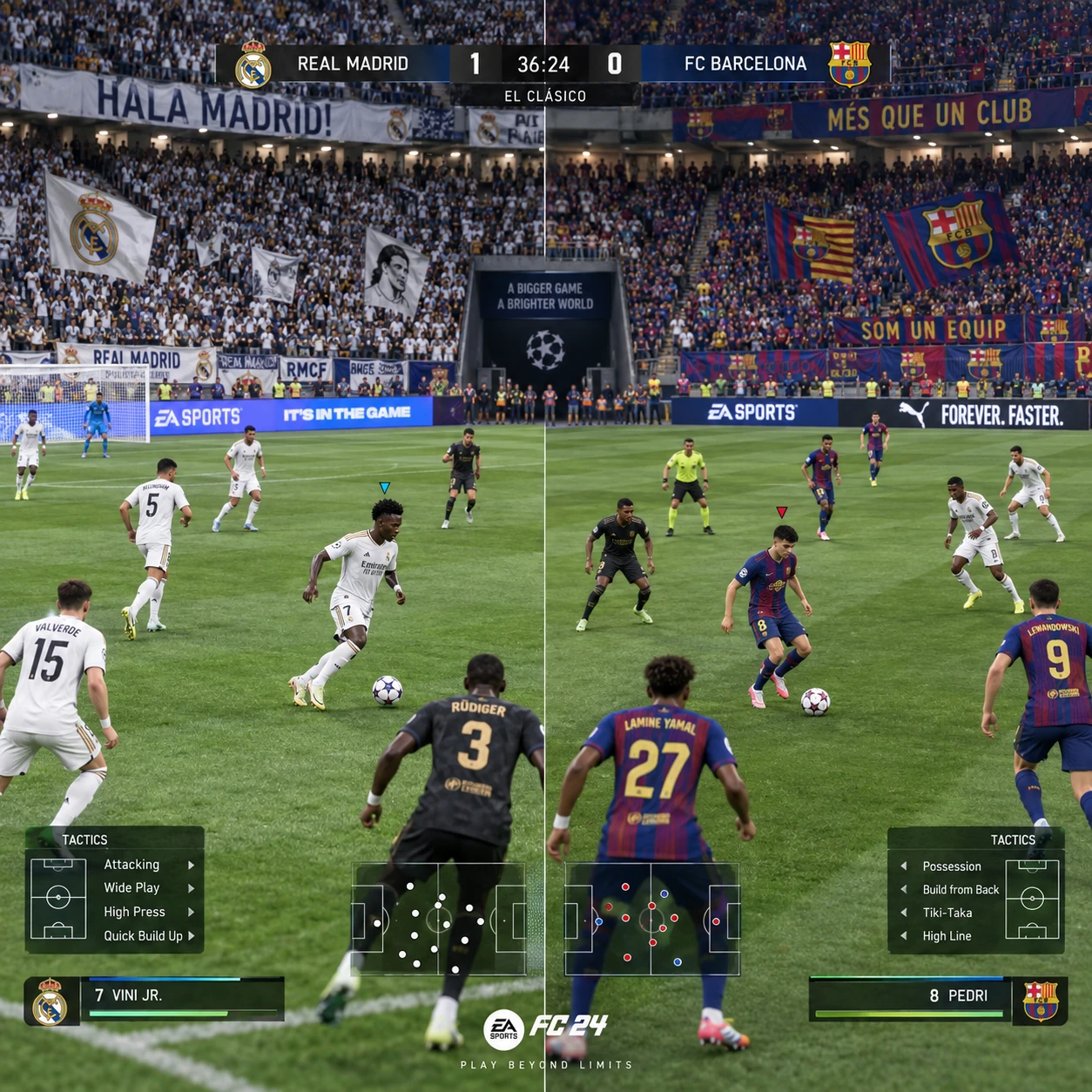
PES and FIFA have long offered different answers to the same question: what should a football game feel like? One player may value careful build-up and responsive control; another may want lifelike presentation, familiar teams, and a broad menu of modes. Neither series can claim realism on every front.
Comparing them fairly means separating the feel of a match from everything around it. Gameplay mechanics, ball physics, player movement, tactical systems, licensing, career-style modes, and online competition all shape the experience, but they do not measure the same thing.
What “Simulation” Means in a Football Game
A football simulation recreates the decisions and uncertainty of the sport through its controls, ball behavior, player movement, tactics, and match flow. PES and FIFA should be judged across those elements rather than by graphics or licenses alone.
A useful way to assess realism is to look at four parts of play:
- Control: Do inputs produce clear, predictable actions, and can small changes in direction or power matter?
- Ball physics: Do passes, rebounds, shots, and deflections feel varied and connected to the action?
- Team behavior: Do players keep shape, create useful passing options, and respond to tactical instructions?
- Match flow: Do attacks, transitions, and defensive recoveries develop at a believable pace?
These criteria can point in different directions. A game may deliver convincing stadium atmosphere and licensed kits while making matches feel too fast or predictable. Another may reward patient build-up yet offer less variety in presentation or team access. Edition matters, too: changes to controls, animations, and balance can shift the comparison, so broad series reputations are a guide, not a guarantee.
Gameplay, Controls, and Match Flow
PES has often been associated with deliberate build-up and a strong sense of direct control, while FIFA has often emphasized responsiveness and fluid transitions. Which feels more realistic depends on whether you prioritize physical, variable play or immediate action and tempo.
In PES, passing and movement have traditionally encouraged players to read space before releasing the ball. A slightly mistimed pass or heavy touch can disrupt an attack, and the ball may feel less locked to the player. That can make possession more satisfying, though it can also frustrate players who expect a teammate to reach a pass automatically.
FIFA has often made it easier to move the ball quickly and connect attacks through responsive passing and player switching. This can produce exciting, accessible matches, but a brisk tempo may make transitions feel more frequent than they would in a measured simulation. Neither pattern is universal across editions or difficulty settings.
Physical play matters in both. Body position, momentum, contact, and player attributes influence whether a player can shield the ball or win a challenge. To judge ball physics and player movement for yourself, try the same test in each game: receive under pressure, turn away from a defender, and play a short pass into space. Notice whether the outcome reflects your timing and the players’ positioning, or whether animations and assistance seem to decide it for you.
Practical test: Play several matches without relying on sprinting. If you can create chances through angles, first touches, and varied passing, the game is giving you room to control the match rather than simply chase its pace.
Tactics, Team Identity, and Player Skill
Both series offer tactical systems, but the deeper simulation is the one where your setup produces visible changes in team shape and where good decisions still need accurate execution.
PES has often appealed to players who want to shape a match through formation, support distance, pressing, and defensive line choices. FIFA also provides formations, instructions, and approaches to pressing or width. The number of menu options alone does not tell you how much tactical control a game offers; what matters is whether your choices change how players behave once the ball is moving.
Team identity is a useful test. Set up a side to press high, then switch to a compact defensive block. Do players close passing lanes and recover into shape, or does the match play much the same either way? Try changing width or support runs, too. Clear effects make planning meaningful; subtle or inconsistent effects can make tactics feel like paperwork.
Player skill also depends on more than reaction speed. Reading the opponent, choosing when to release the ball, controlling the first touch, and defending without dragging a center-back out of position all shape results. Assistance settings and online connection can soften or amplify those skills. A game may have tactical depth on paper, but if outcomes feel dominated by automated movement or timing windows, some players will experience less agency.
For a fair comparison, use similar teams and difficulty settings, then replay a few tactical situations. One match can be decided by a lucky deflection; repeated patterns tell you more about the system.
Modes, Licensing, and Presentation
FIFA has generally been known for broad licensing and a polished broadcast style, while PES has offered its own career and Master League experiences. Modes and presentation add immersion, but they are separate from on-pitch simulation.
Team names, kits, stadiums, commentary, and walkouts help a match feel connected to real football. FIFA’s extensive licensing has often made it easier to find familiar clubs and competitions in one place. PES has at times had gaps in official team or competition licenses, although the exact situation varies by edition and platform. Licensing can be decisive if you want to recreate a particular league without edits, but it does not determine whether passing or defending feels convincing.
Career and Master League modes shape the longer-term experience. Career-style play typically puts you in charge of a club or player over seasons, while Master League has been associated with managing a team across transfers, development, and competition. Mode features, availability, and depth change between releases, so check the specific edition rather than assuming every past feature remains.
Presentation has a trade-off: broadcast detail can make the first minutes of a match more immersive, while frequent cutaways or lengthy menus may slow down repeat play. If you mainly play offline seasons, compare squad management, progression, and match variety. If you jump straight into quick matches, those mode differences may matter much less.
Online Play and Competitive Appeal
Online play affects how a football game feels as a simulation because connection quality, matchmaking, and competitive balance influence the outcome alongside tactics and control. Neither offline realism nor esports popularity alone settles which game simulates football better.
Online matches add human unpredictability. An opponent can press aggressively, protect a lead, or exploit a weakness that computer-controlled teams rarely target in the same way. That makes adaptation part of the challenge. Yet latency can delay inputs, disrupt timed passes, or make tackles feel inconsistent, so a match played over a poor connection is a weak test of gameplay mechanics.
Both FIFA and PES have supported online competition in different forms across their histories, including ranked matches and team-building modes. Their esports scenes, formats, and player populations vary by edition and year. For that reason, check the current game’s active modes and local player base before choosing based on competitive access.
For a fair online test, play several matches at different times, note connection quality, and focus on repeated patterns rather than a single result. Ask whether you can create chances through decisions, whether defending feels responsive, and whether the same tactics dominate every opponent. Competitive appeal is useful evidence about depth, but it is not a pure measure of simulation.
Which Game Is the Better Fit for You?
PES may suit players who prioritize measured possession and hands-on control, while FIFA may be a better fit for players who value licensed teams, broadcast presentation, and broad mode access. The stronger football simulation is the one whose match mechanics reward the kind of football you want to play.
Use this quick decision guide:
- Choose PES if: you prefer patient build-up, want to test your control of passing and space, and are comfortable checking which teams and modes are included in a particular edition.
- Choose FIFA if: official licenses, familiar presentation, and a wide range of football experiences matter more to you, and you enjoy a responsive, often faster match rhythm.
- Try both if: tactics and ball physics are your main concern. Play the same scenario in each game before deciding; a demo, trial, or borrowed copy can reveal more than screenshots or reputation.
One common mistake is treating realism as a single score. That overlooks differences between simulation, presentation, and content. Another is judging a game only by its default controls: adjust assistance, difficulty, and camera settings before deciding that passing or defending lacks depth.
For newcomers, start with the game that makes it easiest to access the teams and modes you want. Then raise the difficulty gradually and learn to vary your attack rather than relying on sprinting or one repeated move. For dedicated simulation fans, compare control and match flow first, then weigh licenses and modes. The verdict is edition-specific, but the right test is simple: does the game let your football decisions shape what happens next?
Frequently Asked Questions
Which is more realistic, PES or FIFA?
There is no single answer across every edition. PES has often been praised for deliberate control and build-up, while FIFA has often offered stronger licensing and presentation. Compare the specific versions on ball behavior, movement, tactics, and match flow.
Which game offers more tactical control?
Both include formations and team instructions. The better choice is the one where changing those settings leads to clear, consistent changes in player behavior during a match.
Does online play affect which game feels more like a simulation?
Yes. Human opponents create varied tactical challenges, but latency can undermine control and make outcomes feel less consistent. A stable connection is essential for judging online gameplay fairly.
Which should a newcomer choose?
Choose based on the teams, modes, and presentation you want, then test the gameplay at a comfortable difficulty. If possible, try both editions before paying; familiarity with one control scheme can otherwise skew the comparison.